Field guide
Water quality is the environment in which shrimp feed, breathe, grow and respond to stress. A pond may appear normal at the surface while important changes are developing in dissolved oxygen, pH, temperature, salinity, alkalinity or nitrogen compounds.
Successful monitoring therefore depends on more than checking one value. Farmers need consistent measurements, correct sampling times, reliable records and an understanding of how parameters influence one another.
The reference ranges in this article are general management guides. Farm-specific targets should account for shrimp species, life stage, stocking density, salinity, pond design, weather, feeding intensity and advice from a qualified aquaculture professional.
Essential points
What to remember
Dissolved oxygen should be checked near dawn because that is commonly when pond oxygen is lowest.
pH should be interpreted as a daily trend; large morning-to-afternoon changes can signal unstable pond biology.
Temperature and salinity changes should be gradual because sudden shifts may stress shrimp.
Ammonia, nitrite and alkalinity must be interpreted together with pH, temperature, oxygen and feeding conditions.
Dissolved Oxygen: The First Parameter to Protect
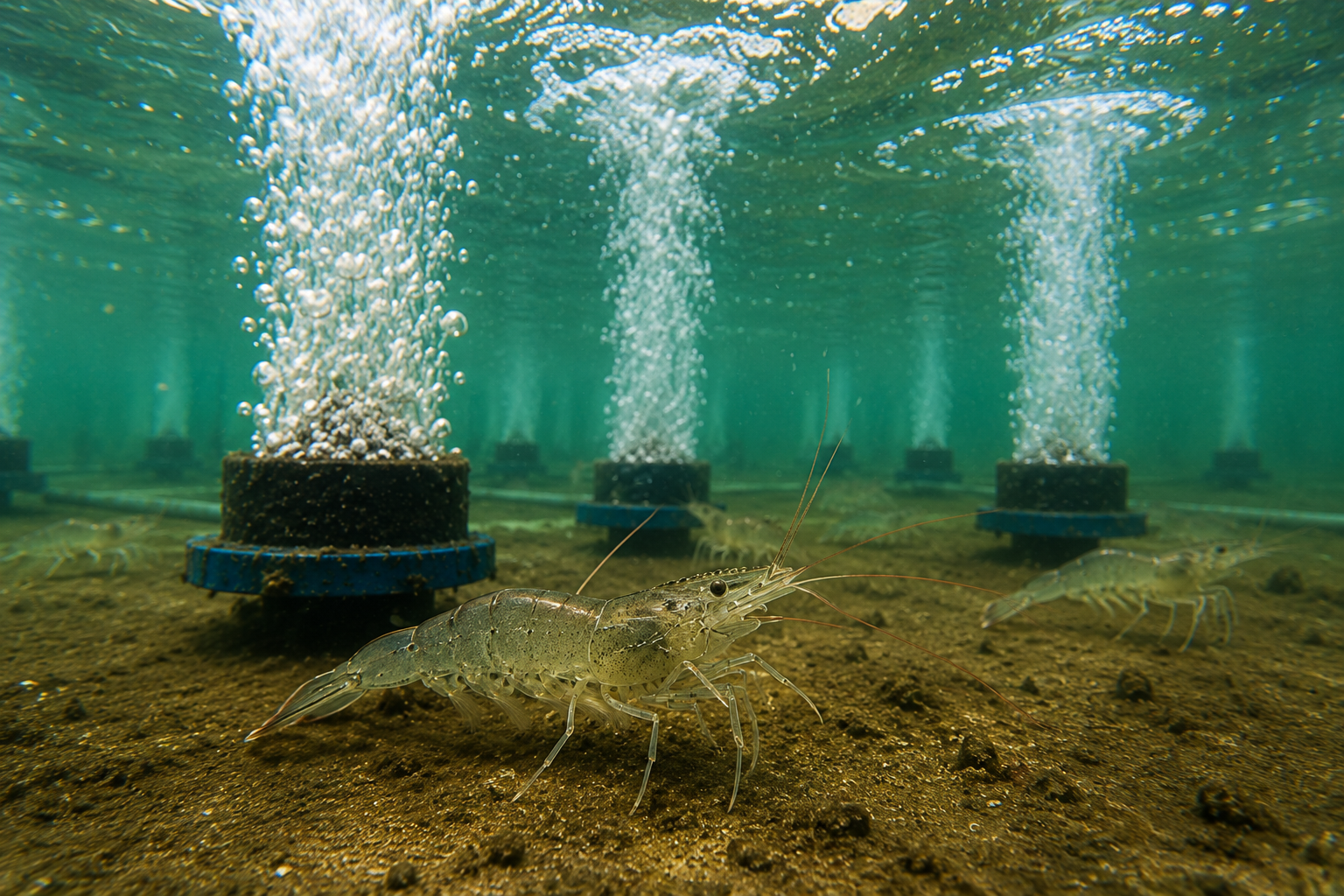
Dissolved oxygen supports shrimp respiration, feed utilisation and the beneficial biological processes that transform organic waste and nitrogen compounds.
Oxygen normally changes throughout the day. Photosynthesis can increase oxygen during daylight, while shrimp, plankton and microorganisms continue consuming oxygen at night. For this reason, the lowest concentration is often observed close to sunrise.
A commonly used management objective is to keep dissolved oxygen near or above 5 mg/L, but the correct response should consider biomass, temperature, feeding rate, weather and pond conditions.
- Measure before sunrise and again during the afternoon.
- Check multiple pond locations and depths when possible.
- Increase aeration when biomass, feeding or organic load rises.
- Treat reduced feeding or unusual surface behaviour as warning signs.
Monitoring panel
Pond pH and Daily Stability
pH influences shrimp physiology, pond productivity and the toxicity of compounds such as ammonia. FAO shrimp guidance commonly describes approximately pH 7.5 to 9.0 as suitable, while narrower farm targets may be used according to the culture system.
A single pH result is less informative than the daily pattern. Morning pH is generally lower after overnight respiration, while afternoon pH may rise as photosynthesis removes carbon dioxide.
Large daily swings may indicate excessive plankton activity, limited buffering or unstable pond conditions. Management should focus on the cause of instability rather than reacting to one isolated reading.
- Measure at consistent morning and afternoon times.
- Track the daily difference as well as the absolute value.
- Interpret pH together with alkalinity, plankton condition and ammonia.
Daily pH rhythm
Water Temperature and Shrimp Metabolism
Temperature influences shrimp metabolism, appetite, oxygen demand, growth and the chemical balance between ammonium and un-ionized ammonia.
Published shrimp-farm guidance often cites approximately 28 to 33°C as a useful reference range, but the appropriate target depends on species, life stage, acclimation and local production conditions.
Warm water holds less dissolved oxygen while biological oxygen demand may increase. Sudden cooling after heavy rain can also change pond mixing and shrimp behaviour.
- Measure at a consistent depth and location.
- Record morning and afternoon temperatures.
- Avoid sudden temperature changes during water exchange.
Salinity and the Importance of Gradual Change
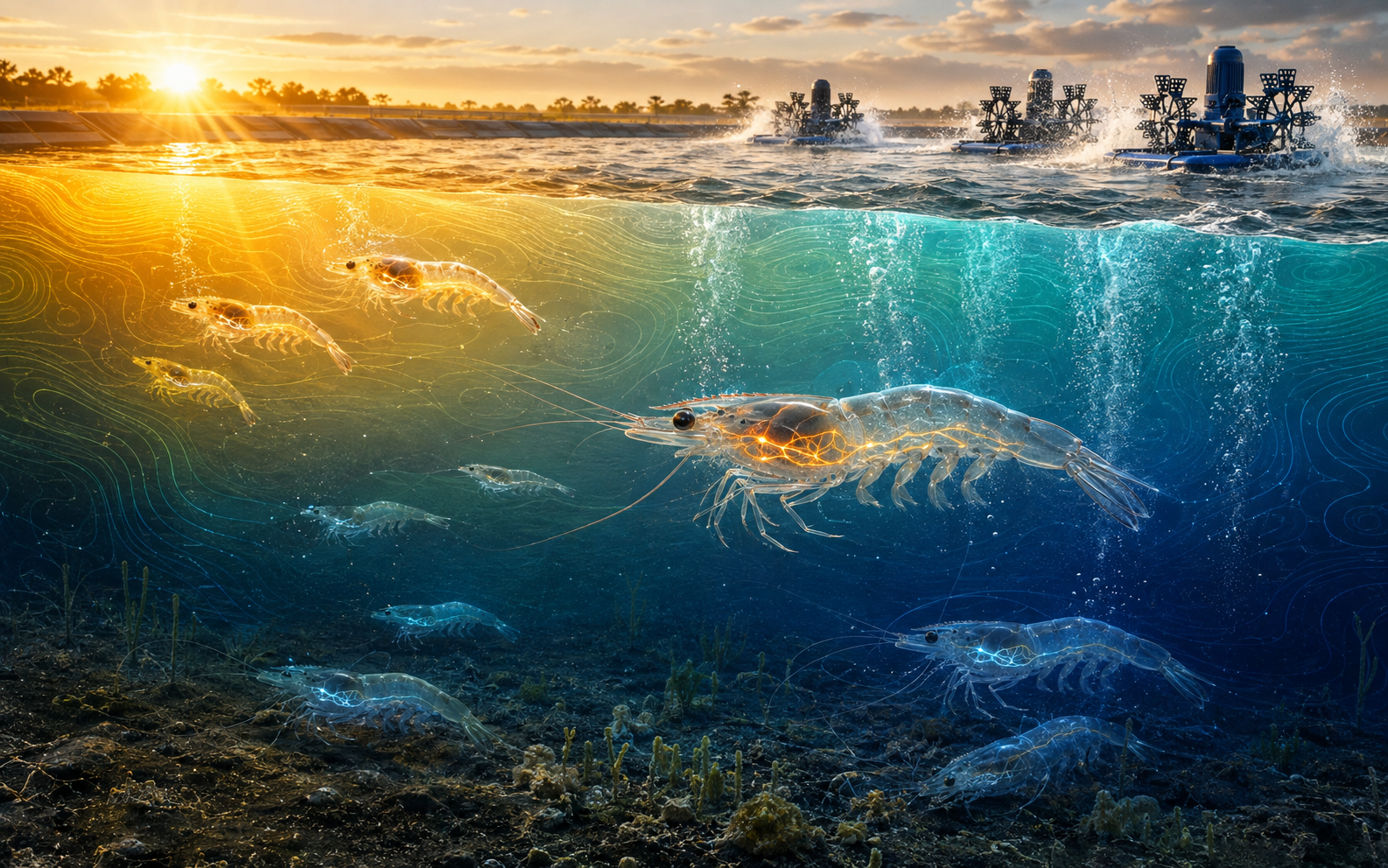
Vannamei shrimp can be cultured across a broad salinity range when properly acclimated, but rapid salinity change can create osmotic stress even when the final value would normally be tolerated.
Some traditional shrimp-farm guidance lists approximately 15 to 35 ppt as a reference range. Modern Vannamei farms may operate outside this range, so a universal target should not be applied without considering local water chemistry and acclimation.
Rainfall, evaporation, source-water changes and water exchange can shift pond salinity. The rate of change is often as important as the measured value.
- Measure source water and pond water before exchange.
- Check salinity after heavy rainfall or prolonged hot weather.
- Make changes gradually and maintain acclimation records.
Alkalinity, Hardness and Pond Buffering
Total alkalinity represents the water's capacity to neutralise acids and resist sudden pH change. It supports pH stability and biological processes involved in pond productivity and nitrification.
Hardness describes dissolved calcium and magnesium and is not the same as alkalinity. Both can matter in low-salinity culture, mineral balance and shrimp moulting management.
Required levels vary by production system and source-water chemistry. Results should be reviewed as trends and interpreted alongside pH, salinity and mineral composition before corrective products are selected.
- Do not treat alkalinity and hardness as identical measurements.
- Use laboratory or field-kit results to guide mineral management.
- Avoid large, unverified corrective applications.
Pond buffering system
HCO₃⁻
Alkalinity
Buffers acids
Ca²⁺ Mg²⁺
Hardness
Mineral support
More stable pond chemistry
pH stability • mineral balance • biological activity
Related—but not the same measurement.
Ammonia and Nitrite: Key Nitrogen Risks
Feed, shrimp waste, dead plankton and organic sludge contribute nitrogen to the pond. Microorganisms transform these materials through a cycle that includes ammonia, nitrite and nitrate.
The toxicity of ammonia depends strongly on pH and temperature because these conditions influence the proportion present as un-ionized NH₃. A TAN result should never be interpreted by itself.
Nitrite can interfere with oxygen transport and may become more concerning under low-chloride conditions. The correct response depends on concentration, salinity, chloride, oxygen, feeding and pond biology.
- Review feeding and organic loading when nitrogen compounds rise.
- Interpret TAN with pH and temperature.
- Interpret nitrite with salinity or chloride conditions.
- Maintain aeration to support biological nitrogen conversion.
Nitrogen pathway
Feed
Shrimp waste
Dead plankton
Sludge
NH₃/NH₄⁺
Ammonia
NO₂⁻
Nitrite
NO₃⁻
Nitrate
Transparency, Plankton and Pond Colour
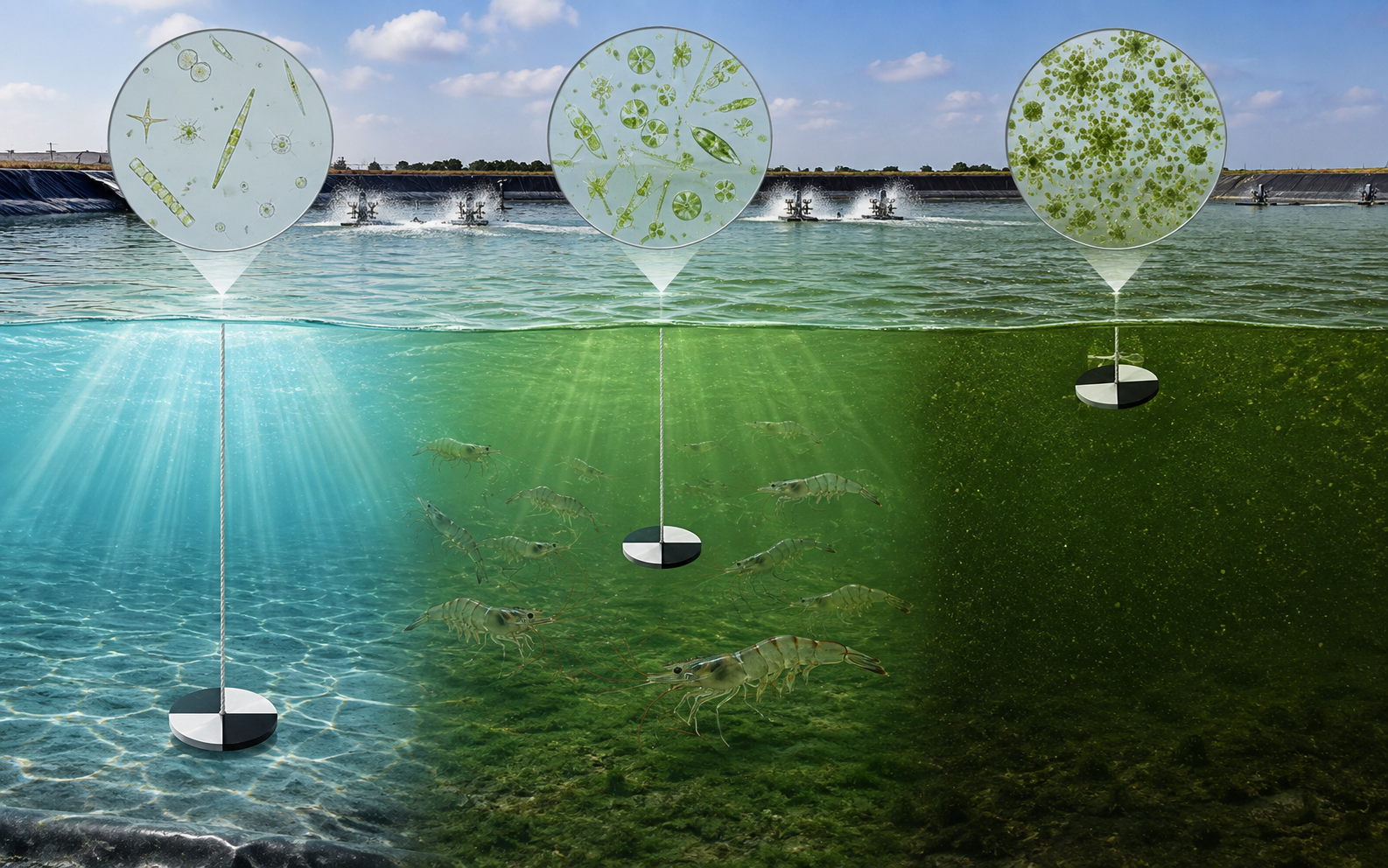
Transparency provides a practical indication of suspended particles and plankton density. Traditional shrimp guidance commonly references Secchi-disc visibility around 25 to 45 cm, but interpretation depends on pond depth, soil particles, plankton type and culture intensity.
Very dense plankton can produce high afternoon oxygen and pH but also consume substantial oxygen overnight. Sudden colour loss may indicate a plankton crash and increased organic decomposition.
Pond colour should be assessed together with Secchi depth, dissolved oxygen, pH trend and microscopic or laboratory observations when available.
Build a Consistent Pond Monitoring Plan
Useful monitoring is consistent, comparable and connected to management decisions. Measure at the same locations, depths and times whenever possible, and record weather, feeding, aeration and shrimp behaviour alongside numerical results.
Parameters that can change quickly, such as dissolved oxygen, temperature and pH, generally require more frequent checking than slower-changing parameters. Monitoring frequency should increase during high biomass, unstable weather, plankton changes or disease-risk periods.
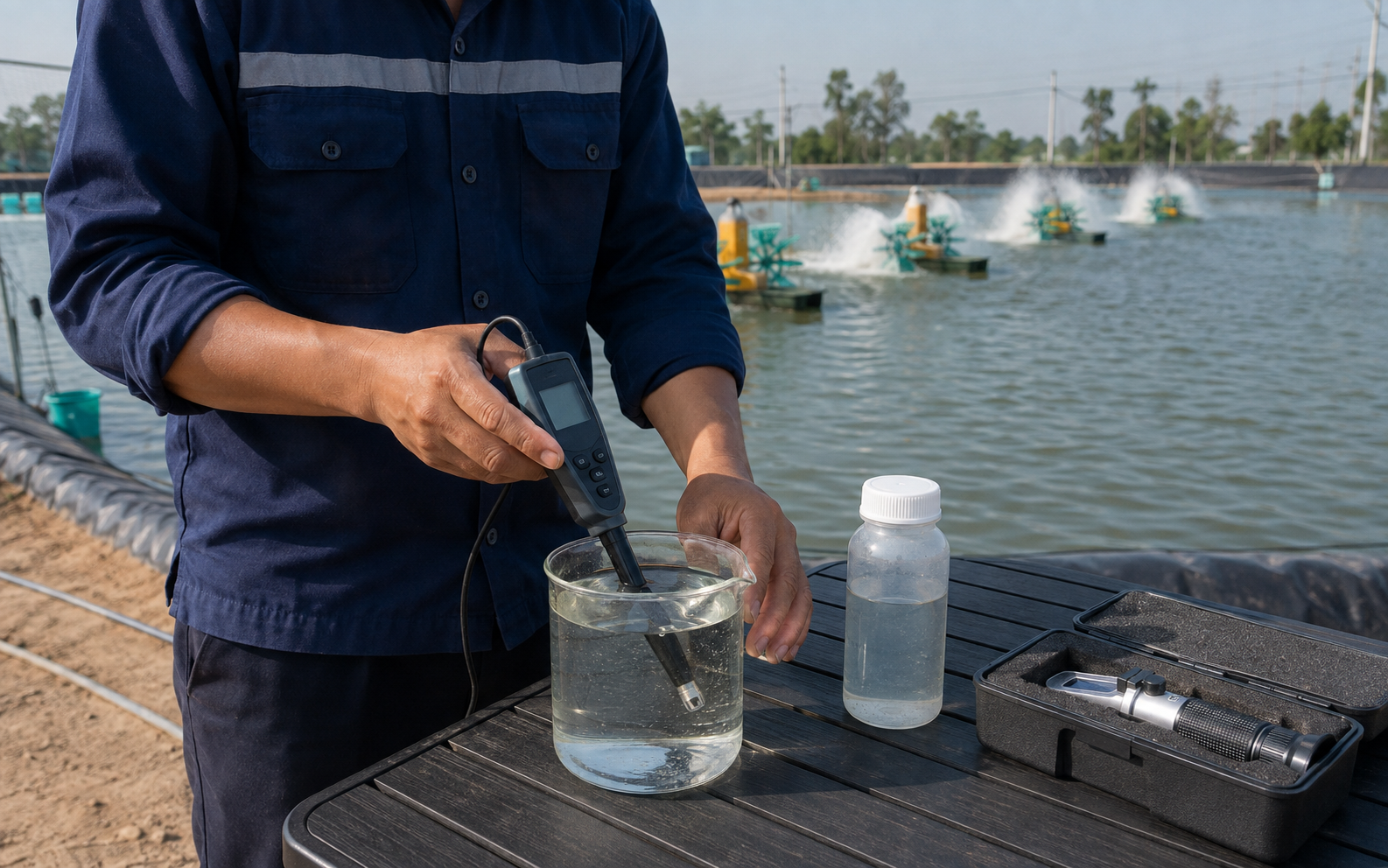
Meters and test kits should be maintained, calibrated and used according to the manufacturer's instructions. A questionable result should be checked before a major corrective action is taken.
- Before sunrise: dissolved oxygen, temperature and shrimp behaviour.
- Afternoon: dissolved oxygen, temperature and pH.
- Routine schedule: salinity, alkalinity, ammonia, nitrite and transparency.
- After rain or water exchange: recheck temperature, pH and salinity.
- Record every intervention and measure the pond response.
Management cycle
Measure
Collect reliable readings
Interpret
Compare trends
Act
Apply targeted action
Review
Measure response
Quick answers
Frequently asked questions
01What is the most important water-quality parameter in a shrimp pond?+
Dissolved oxygen is often the first parameter to protect because shrimp and beneficial pond processes depend on it. However, water quality must be managed as an interacting system rather than by one value alone.
02When should dissolved oxygen be measured?+
Measure near sunrise, when oxygen is commonly lowest, and again during the afternoon. High-density or unstable ponds may require additional night-time checks.
03What pH is suitable for shrimp ponds?+
FAO shrimp guidance commonly describes approximately pH 7.5 to 9.0 as suitable. Farm targets should also consider daily fluctuation, alkalinity, plankton condition and ammonia.
04Which parameters should be checked after heavy rain?+
Check dissolved oxygen, temperature, pH and salinity first. Also observe pond mixing, shrimp behaviour, water colour and the need for additional aeration.
05Can one target range be used for every shrimp farm?+
No. Suitable ranges and action thresholds vary with species, life stage, salinity, stocking density, production system, weather and local water chemistry.
Technical references
- 01
FAO Water Quality Management. Shrimp-production guidance covering pond pH, dissolved oxygen, temperature, transparency and water-quality management.
- 02
FAO Shrimp Farm Guidelines. Reference ranges and monitoring guidance for temperature, pH, dissolved oxygen, salinity, alkalinity and nitrogen compounds.
- 03
Farm-specific interpretation. Final targets and interventions should be based on reliable measurements, local production conditions and qualified technical guidance.

About the author
Innovare Biopharma Technical Team
Aquaculture Technical & Product Knowledge Team
The Innovare Biopharma Technical Team develops practical educational resources covering shrimp health, aquaculture water quality, nutrition, microbial management and responsible pond-management strategies.
Published: 13 August 2026
Reviewed: 13 August 2026
Continue learning