Field guide
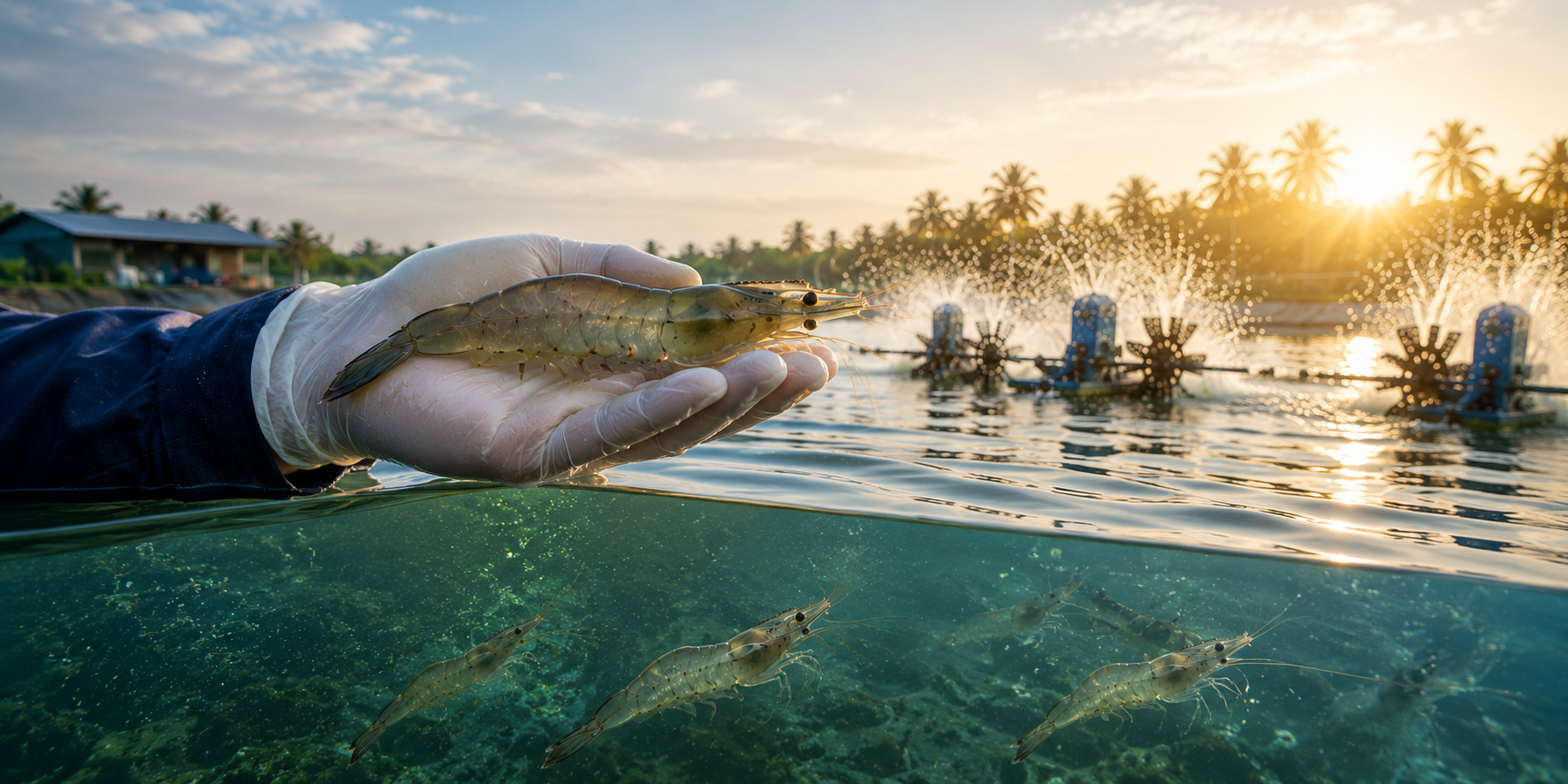
Shrimp health problems do not always begin with sudden mortality. Changes in feeding response, swimming behaviour, distribution, appearance or moulting may become visible before a more serious production problem develops.
These observations are useful warning signals, but they should not be treated as a diagnosis by themselves. Similar signs can occur because of low dissolved oxygen, unsuitable pH, ammonia, temperature changes, salinity shifts, poor bottom conditions, disease or other environmental pressures.
A practical early-warning system combines daily shrimp observation with feed-tray checks, water-quality measurements, pond records and appropriate technical or laboratory investigation when abnormal signs persist.
Essential points
What to remember
Reduced or unusual feeding response can be an early sign that pond conditions have changed.
Abnormal swimming, surface activity or shrimp gathering near pond edges should trigger immediate observation and water-quality checks.
Changes in body colour, gut appearance, shell condition and moulting can provide useful health information.
Shrimp behaviour should be interpreted together with dissolved oxygen, pH, ammonia, temperature, salinity and recent pond-management changes.
Why Early Warning Signs Matter in Shrimp Farming
Shrimp are continuously exposed to changes in water quality, weather, feeding, pond biology and bottom conditions. Their behaviour and appearance can therefore provide useful information about changes occurring within the culture environment.
Recognising an abnormal pattern early gives farm managers an opportunity to verify water quality, review feeding and aeration, inspect pond conditions and determine whether further health investigation is required.
The objective is not to diagnose a problem from one visual sign. Observations should instead be used as part of an early-warning system that identifies when a pond is behaving differently from its normal pattern.
Relationship
Pond parameters should be interpreted together.
1. Reduced or Unusual Feeding Response
Feed consumption is one of the most practical indicators available to shrimp farmers. A sudden reduction in feed-tray consumption or a feeding response that differs from the pond's established pattern deserves attention.
Reduced appetite can be associated with several factors, including unsuitable dissolved oxygen, temperature changes, water-quality deterioration, moulting activity, weather changes or health problems.
Recent feed records, water-quality results, weather and shrimp observations should be reviewed together before management changes are made.
- Compare feed-tray consumption with previous days.
- Check dissolved oxygen and temperature when appetite changes suddenly.
- Review recent rainfall, weather and water-quality changes.
- Avoid unnecessary feeding when shrimp are not consuming feed normally.
Monitoring panel
2. Abnormal Swimming or Activity
Healthy shrimp behaviour varies with culture stage, feeding time, pond conditions and time of day. Sudden changes from the normal pond pattern can therefore be more informative than one isolated observation.
Unusual swimming, weak movement, erratic activity or unexpected surface activity may indicate environmental or physiological stress.
When abnormal activity is observed, water quality should be checked promptly before assuming that the cause is disease.
Monitoring panel
3. Shrimp Gathering Near Pond Edges or the Surface
Shrimp concentrating in unusual areas of the pond can indicate that conditions are not uniform. Pond circulation, dissolved oxygen, bottom condition and water quality may vary between locations.
Unexpected early-morning surface or edge activity deserves particular attention because dissolved oxygen may be near its daily minimum at this time.
Observations should be followed by measurements from relevant pond locations rather than relying on a single water sample.
- Check dissolved oxygen immediately.
- Inspect aerator operation and circulation.
- Compare readings from different pond locations when possible.
- Review recent feed input and organic loading.
Relationship
Pond parameters should be interpreted together.
4. Changes in Body Colour or External Appearance
Changes in shrimp appearance can provide useful health information when compared with the normal appearance of shrimp from the same pond and culture stage.
Unusual colouration, shell appearance, fouling or visible external abnormalities should be recorded and examined carefully.
Visual changes are not specific to one condition. Persistent abnormalities may require professional or laboratory assessment.
5. Changes in Gut Appearance and Feed Intake
Gut appearance can complement feed-tray observations when farmers assess whether shrimp are feeding consistently.
A noticeable change in gut fullness across sampled shrimp, particularly when accompanied by reduced feed consumption or abnormal behaviour, can indicate that pond conditions should be investigated.
Sampling should be consistent and observations should be compared with normal pond patterns rather than interpreting one shrimp in isolation.
Monitoring panel
6. Irregular Moulting or Shell-Condition Changes
Moulting is a normal part of shrimp growth and is influenced by life stage, nutrition, minerals, salinity and environmental conditions.
When unusual moulting patterns or shell-condition changes occur together with poor feeding or abnormal behaviour, farmers should review water chemistry, mineral balance and overall pond stability.
Because moulting naturally changes shrimp appearance and behaviour, observations should be interpreted in the context of the culture cycle.
Relationship
Pond parameters should be interpreted together.
7. Weak Response or Reduced Activity
A noticeable reduction in normal activity or responsiveness can be an important warning sign, especially when it occurs across multiple sampled shrimp.
Low dissolved oxygen, rapid environmental change, poor water quality and health problems are among the factors that may contribute to weak behaviour.
Immediate measurements and comparison with recent pond records can help determine whether an environmental change is occurring.
Monitoring panel
Check Water Quality When Shrimp Behaviour Changes
Many visible stress signs overlap with water-quality problems. Checking the pond environment is therefore an important first step whenever feeding or behaviour changes unexpectedly.
Results should be interpreted as a connected system. High pH can increase the proportion of more toxic un-ionised ammonia, while high temperature can reduce oxygen solubility and influence shrimp metabolism.
- Dissolved oxygen.
- pH and daily pH fluctuation.
- Temperature.
- Ammonia and nitrite.
- Salinity.
- Alkalinity.
- Pond colour and transparency.
- Recent rainfall and weather conditions.
Management cycle
Measure
Collect reliable readings
Interpret
Compare trends
Act
Apply targeted action
Review
Measure response
Build a monitoring rhythm.
Consistency creates useful trends. One isolated measurement rarely tells the complete story.
Build a Daily Shrimp Health Monitoring Routine
The strongest early-warning programme is based on consistent observations rather than occasional inspection after a problem becomes obvious.
Farm teams should establish a repeatable routine covering feeding, shrimp behaviour, water quality, weather, aeration and pond appearance. Records make it easier to identify changes from each pond's normal pattern.
- Observe ponds during early morning rounds.
- Review feed trays consistently.
- Record unusual swimming or pond-edge behaviour.
- Inspect sampled shrimp for gut, shell and external changes.
- Record dissolved oxygen, pH, temperature and other scheduled parameters.
- Note rainfall, cloudy weather and aerator operating changes.
- Escalate persistent or unexplained abnormalities for technical assessment.
Management cycle
Measure
Collect reliable readings
Interpret
Compare trends
Act
Apply targeted action
Review
Measure response
Avoid Diagnosing Shrimp Health from One Sign Alone
A visible sign rarely identifies one specific cause. Reduced feeding, for example, may occur because of environmental stress, weather, moulting or health problems.
Surface activity may be associated with low oxygen but should still be confirmed using reliable measurements.
Management decisions are stronger when visual observations, water-quality results, farm records and appropriate diagnostic evidence are evaluated together.
Observe Early, Measure Quickly and Respond to Evidence
Early detection begins with knowing what normal behaviour looks like in each pond. When feeding, movement, distribution or appearance changes, the next step is to collect reliable information rather than immediately assuming a cause.
Consistent observation combined with water-quality monitoring and good farm records can help identify developing problems earlier and support more informed shrimp-health management.
Management cycle
Measure
Collect reliable readings
Interpret
Compare trends
Act
Apply targeted action
Review
Measure response
Quick answers
Frequently asked questions
01What are common early warning signs of stress in shrimp?+
Possible warning signs include reduced feeding, unusual swimming, unexpected surface or pond-edge activity, changes in body appearance, altered gut fullness, irregular moulting and reduced responsiveness.
02Why do shrimp suddenly stop eating?+
Reduced feeding can occur for several reasons, including low dissolved oxygen, temperature or salinity changes, unsuitable water quality, moulting, weather changes or health problems.
03Why are shrimp gathering near the pond edge?+
Unusual distribution may be associated with differences in dissolved oxygen, circulation, bottom condition or other environmental factors. Water quality should be checked promptly.
04Does unusual shrimp behaviour always mean disease?+
No. Similar behavioural changes can result from water quality, weather, feeding, moulting, environmental stress or health problems. Visual signs alone are not sufficient for diagnosis.
05Which water-quality parameters should be checked when shrimp show stress?+
Important initial checks commonly include dissolved oxygen, pH, temperature, ammonia, nitrite, salinity and alkalinity, together with observations of pond colour, feeding, weather and recent management changes.
Technical references
- 01
Shrimp health monitoring principles. General aquaculture health-management principles relating to routine observation, feeding behaviour and early recognition of abnormal pond conditions.
- 02
Aquaculture water-quality management. Established relationships among dissolved oxygen, pH, temperature, ammonia, salinity and shrimp environmental stress.
- 03
Farm-specific diagnosis. Visible signs are not disease-specific. Persistent abnormalities should be interpreted using pond measurements, production history and appropriate professional or laboratory assessment.

About the author
Innovare Biopharma Technical Team
Aquaculture Technical & Product Knowledge Team
The Innovare Biopharma Technical Team develops practical educational resources covering shrimp health, aquaculture water quality, nutrition, microbial management and responsible pond-management strategies.
Published: 31 August 2026
Reviewed: 31 August 2026
Continue learning